A language exchange should be a trade, not a free lesson that only one person receives. You want to practice their language; they want to practice yours. But without a little structure, it's easy to spend twenty minutes talking in the language you're both already comfortable using—and leave feeling that you never practiced at all.
The solution isn't a rigid classroom. It's a small agreement, a useful topic and a way to divide speaking time fairly. Here's a 15-minute format you can use with a new partner on video, whether you're practicing English, Spanish, Arabic, Turkish or something else.
First: is this a language exchange or a social chat?
A teacher is responsible for explaining language clearly and correcting you. A language-exchange partner is a fellow learner who volunteers their time. A stranger in social video chat hasn't agreed to teach at all.
Before switching into study mode, ask: “I'm learning Spanish and can help you practice English. Would you be interested in a short exchange—about seven minutes in each language?” That single question prevents many awkward conversations.
You can meet language partners in dedicated exchanges, interest communities or online events. Live social video chat can also create opportunities to talk across countries, but a social platform does not guarantee tutors or willing language partners. If you want to explore spontaneous conversation, YOYO Web offers a browser entry; follow the live options and treat the other person as a conversation partner first, not an instructor.
The 15-minute format
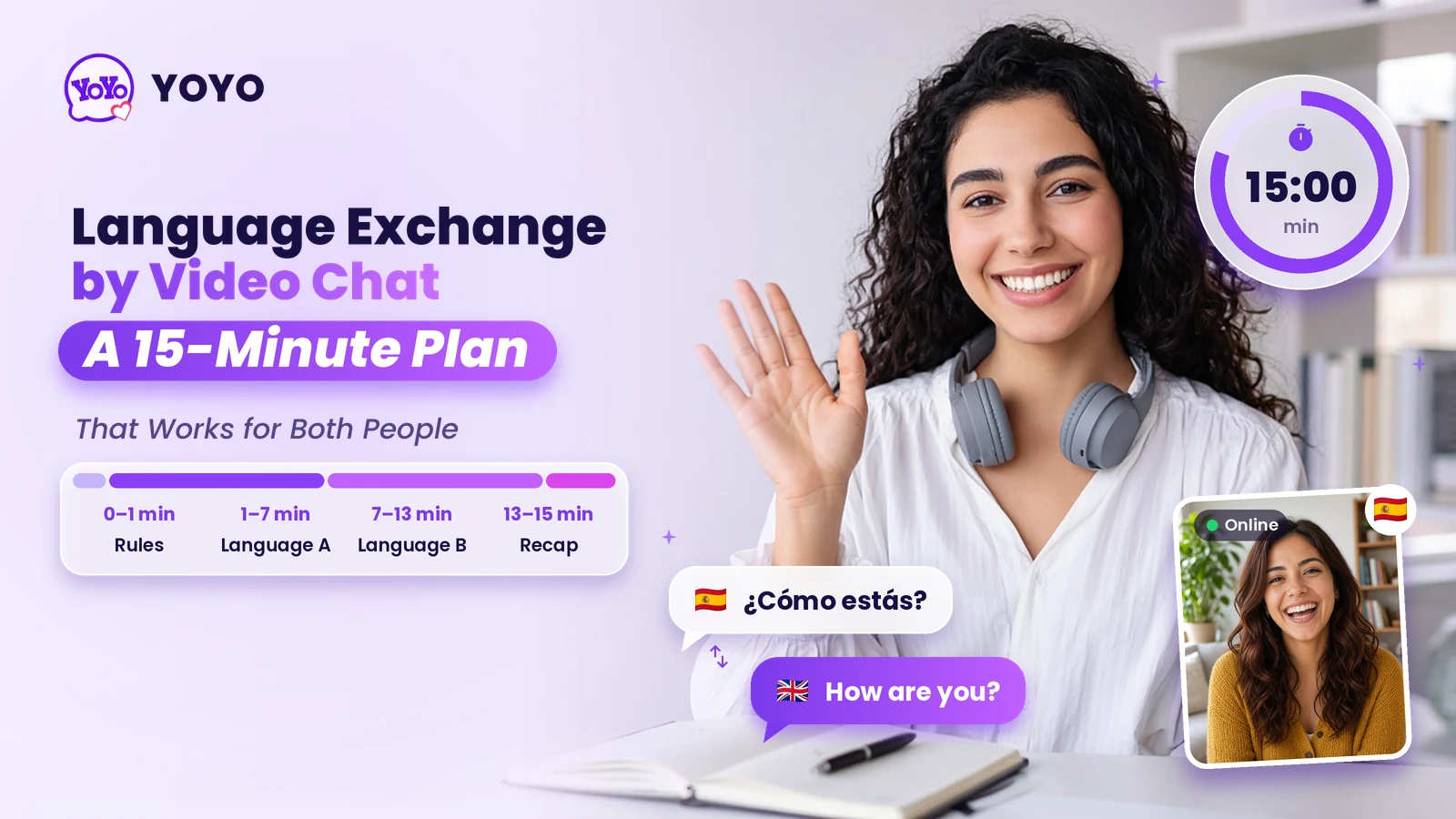
| Time | What happens | Goal |
|---|---|---|
| 0:00–1:00 | Agree on languages and one topic | Make expectations explicit |
| 1:00–7:00 | Speak mostly in Language A | First person practices |
| 7:00–13:00 | Switch to Language B | Second person practices |
| 13:00–14:00 | Exchange one useful correction each | Learn without interruption |
| 14:00–15:00 | Recap and choose a next topic | Make progress repeatable |
The schedule is flexible. If one person is a beginner, you might use shorter turns or allow notes. What's important is that both people get something out of the call.
Minute 0–1: agree on the rules
Try this opening: “Can we do six minutes in Spanish, six in English, then one correction each? We can talk about food.” It's specific, but not formal.
Also ask: “Do you want corrections while you speak, or at the end?” Many learners lose confidence when interrupted after every sentence. Others want immediate help. Neither preference is wrong.
Minutes 1–7: one topic, not twelve questions
For the first language, choose a topic with enough room for stories. A weekend routine, local food, a favorite song or a recent trip can work at several proficiency levels.
Suppose your partner asks about your city. Instead of listing monuments, tell a small story: “There's a café near where I live. I go there on Sunday because they play old records.” Then ask whether they have a similar place. You practice sequencing, descriptions and follow-ups in one natural exchange.
If you are a beginner, use a simple three-part pattern: answer → add one detail → ask back. For example: “I like coffee. I drink it in the morning. What do you drink?” You don't need advanced grammar to keep an exchange mutual.
Minutes 7–13: switch fairly
Actually switch languages. This sounds obvious, but it's the step people skip when one partner has much stronger skills. The stronger speaker can support without taking over: speak more slowly, use shorter sentences and offer a simpler synonym rather than translating every word immediately.
If a topic works well, keep it. Discuss the same music or food question in the other language, which reduces the mental work of inventing a new subject and gives the second person equal speaking time.
Minutes 13–14: one correction that sticks
Choose a correction with high impact, such as an unnatural phrase that came up repeatedly, rather than every small pronunciation mistake. Offer the improved sentence and let your partner repeat it once.
Example:
- Learner: “I am agree with that.”
- Partner: “A natural way is ‘I agree with that.’ Want to try it?”
That's more useful than interrupting a story six times. If your partner doesn't want correction, respect that and share a phrase you enjoyed hearing instead.
Minute 14–15: close with a next step
Each person says one expression they learned and one thing they want to practice next time. Something as simple as “Next time let's talk about our weekends” turns a random exchange into a routine. If you both want to reconnect, use a platform-supported method and don't rush to hand over private contact details.
Five phrases that save a conversation
| When you need… | Say… |
|---|---|
| More time | “Give me a second to find the word.” |
| A slower pace | “Could you say that a little more slowly?” |
| A simpler explanation | “Can you explain that in another way?” |
| A correction | “What's a more natural way to say this?” |
| A fair switch | “Shall we change languages now?” |
It's helpful to send these phrases to your partner before the call. They make asking for help normal rather than embarrassing.
What to do if the exchange isn't balanced
Sometimes the other person is only interested in their target language, or one partner talks far more. You can reset gently: “Could we spend the next five minutes in my target language too?” If they aren't interested, that's okay; a language exchange requires agreement from both sides.
If your partner is much more advanced, split the time by turns rather than by confidence. You can also change the task: a beginner describes a picture; an advanced learner gives an opinion and explains why. Both practice at their own level.
Three ways to measure progress without turning it into homework
Track useful phrases, not perfect scores. After each call, write down three phrases you wanted to say or heard naturally. Review them before the next conversation.
Record yourself, not the other person. After the call, make a private 30-second summary in your own voice and compare it over several weeks. Don't record somebody else's face or voice without consent.
Repeat a familiar topic. Explain your weekend today and again in a month. Notice whether you hesitate less, use more varied verbs or ask better follow-up questions. Those are practical signs of improvement.
What role can video play?
Text gives you time to think and check words. Voice trains listening and speaking. Video adds facial expression, gesture and conversational timing. It can also feel more demanding, especially at the beginning.
If video makes you nervous, start with a shorter call or agree on a topic in writing first. If you use an international social platform such as YOYO, check its current language and entry features; don't assume it supplies live voice subtitles or trained teachers. Our translation guide explains why translated messages and spoken subtitles are different tools.
FAQ
Is 15 minutes enough for language exchange?
It's enough for one focused session, particularly when both speakers get a fair turn. Regular short conversations can be easier to maintain than rare hour-long calls.
Do both people need to be native speakers?
No. Both people need to understand their abilities, agree on the purpose and avoid presenting uncertain corrections as facts. More advanced speakers can still help each other.
Should I correct every mistake?
Usually not. Agree on correction preferences first, and prioritize a small number of changes that improve clarity.
Can I practice with strangers on video chat?
You can practice conversational skills with people who willingly participate. Not every stranger wants a lesson or exchange, so ask first and respect a no.
Two people, one fair conversation
A good exchange leaves both speakers feeling heard and a little more confident. Set a timer, choose one topic, give each language its turn and save a single useful correction. If you'd also like to explore informal international conversations, start at YOYO Web and check the current ways to connect. For more beginner speaking tips, see practicing English through video chat. If you specifically want to practice Korean, see how to meet Korean people online through video chat.