You can know hundreds of English words and still freeze when somebody says, 'So, what did you do today?' That's normal: speaking is a different skill from reading or answering exercises. Live video chat helps because the other person reacts in real time. You have to listen, choose words and keep going — even when your sentence isn't perfect.
You don't need flawless grammar. You need a manageable conversation, a few useful phrases and someone who is willing to speak at a comfortable pace.
Choose the right kind of practice
There are three useful settings. A structured lesson with a teacher is best when you need systematic correction and a curriculum. A language exchange is useful when you can offer your own language in return. Casual social video chat is good for spontaneous listening and confidence, but the person you meet is not automatically your teacher.
If you want to explore a social conversation, YOYO Web is one possible starting point. Check the live site's current entry and language options; don't assume a dedicated tutor, translation function or free calling allowance exists unless the interface actually offers it.
Your first 15-minute speaking routine
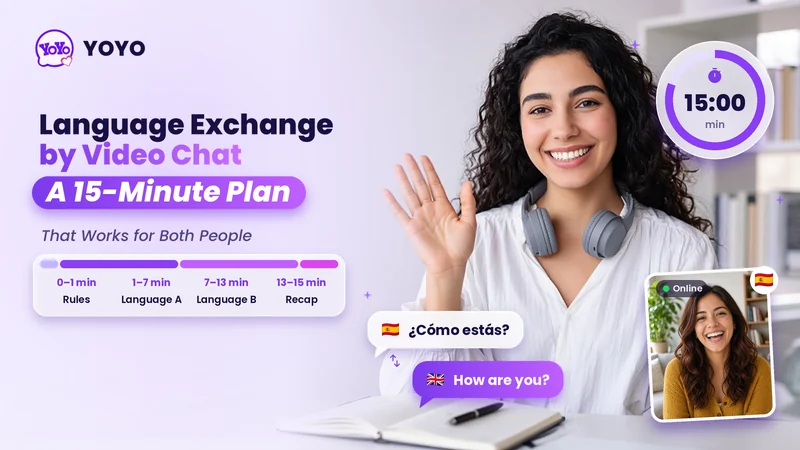
Minutes 0–2: warm up. Say your name or nickname, where you're broadly from and one easy interest. 'Hi, I'm learning English. I like music and movies. Is it okay if we speak a little slowly?'
Minutes 2–5: ask one concrete question. 'What music do you listen to when you're working?' Listen for the main idea, not every word.
Minutes 5–10: follow a topic. If they mention a band, ask 'How did you discover them?' Share your answer. Two follow-ups make a chat more natural than ten unrelated questions.
Minutes 10–13: request one correction. 'Could you tell me one phrase I could say more naturally?' Asking for a single correction is less disruptive than stopping after every sentence.
Minutes 13–15: review and close. Repeat one new phrase out loud. Thank the other person and end politely. After the call, write down three expressions you actually heard.
Ten simple questions that work
- What do you usually do on weekends?
- What's your favorite food from your hometown?
- Which movie did you watch recently?
- What's the weather like where you are?
- Is there a place in your city you'd recommend?
- What's one song you can't stop playing?
- Do you prefer mornings or late nights?
- What are you looking forward to this month?
- Have you learned anything new recently?
- What's something people misunderstand about your country?
These questions are ordinary on purpose. They let you practice past, present and future tense without turning the call into an oral exam.
Phrases to use when you get stuck
| Situation | Useful phrase |
|---|---|
| You missed a word | 'Sorry, could you say that again?' |
| They speak too quickly | 'Could you speak a little more slowly?' |
| You need time | 'Give me a second to think.' |
| You don't know a word | 'How do you say this in English?' |
| You want to check meaning | 'Do you mean that…?' |
| You want feedback | 'Is there a more natural way to say that?' |
| You want to finish | 'It was nice talking with you. I have to go now.' |
Memorize two or three first. You won't need every line in every call.
How to improve without getting discouraged
Choose one skill per session. On Monday, practice asking follow-up questions. On Wednesday, try describing what happened yesterday. On Friday, practice explaining an opinion and giving a reason. Record a short summary of your own speech after the call, rather than recording another person without permission. You can compare your summaries after a month to notice whether you pause less and express ideas more clearly.
Don't mistake a stranger's impatience for a measure of your English. Some people simply don't want to do a language exchange. Say thanks and find a more compatible conversation. In a genuine exchange, both speakers agree on the goal.
A good correction rule
If you're chatting for fun, interrupting every sentence can ruin the flow. Instead, ask your partner to note one or two recurring issues and share them at the end. Correct meaning first, then style. For example, 'I am agree' becomes 'I agree'; it is more helpful than receiving ten tiny pronunciation comments while you are trying to tell a story.
Stay safe while practicing
Practice does not require revealing your exact address, school, employer or phone number. Avoid sending documents or clicking unfamiliar payment links. Be wary of anybody offering a paid 'certificate' or private lesson you didn't request. Use official platform controls to leave, block or report. If you're under the platform's minimum age, don't use it; choose an age-appropriate supervised learning service instead.
Frequently asked questions
Can beginners practice English with strangers?
Yes, provided the platform permits your age and the other person agrees to the exchange. Start with very short conversations and prepared questions.
Is video better than text for speaking practice?
Video gives you real-time listening and speaking practice, while text gives you more time to think. Both can help; choose based on your current goal.
What should I do if I don't understand an accent?
Ask for a slower repetition, confirm the main meaning, and avoid pretending you understood. Exposure to different accents can improve listening over time.
How often should I practice?
Consistency matters more than marathon calls. Even a focused 10–15 minute conversation several times a week can give you more opportunities to speak.
Make the next call a little easier
Pick three questions from this article, keep one rescue phrase nearby and try a short conversation. If social video chat appeals to you, explore YOYO Web and review the options and costs shown on the live page. You can also read our guide to international video chat.