You can study Spanish for months and still freeze when someone asks a simple question on a live call. The problem is not necessarily vocabulary. Real conversations move between accents, jokes, interruptions and topics that a textbook never predicted. The easiest way to become more comfortable is to speak with people who actually want to have that conversation.
That last part matters. Spanish speakers are not one giant language-teaching service. Many are simply looking to make friends, talk about music, play games or meet someone with similar interests. A good conversation makes room for both people.
Quick answer: Find a language-exchange partner or join a Spanish-speaking interest community that welcomes live calls. Introduce your level honestly, agree on how much Spanish and English to use, and plan a short first session. If you try a social video service such as YOYO, check the current connection and language features; never assume it can provide a guaranteed Spanish-speaking match on demand.
“Spanish-speaking” covers many different conversations
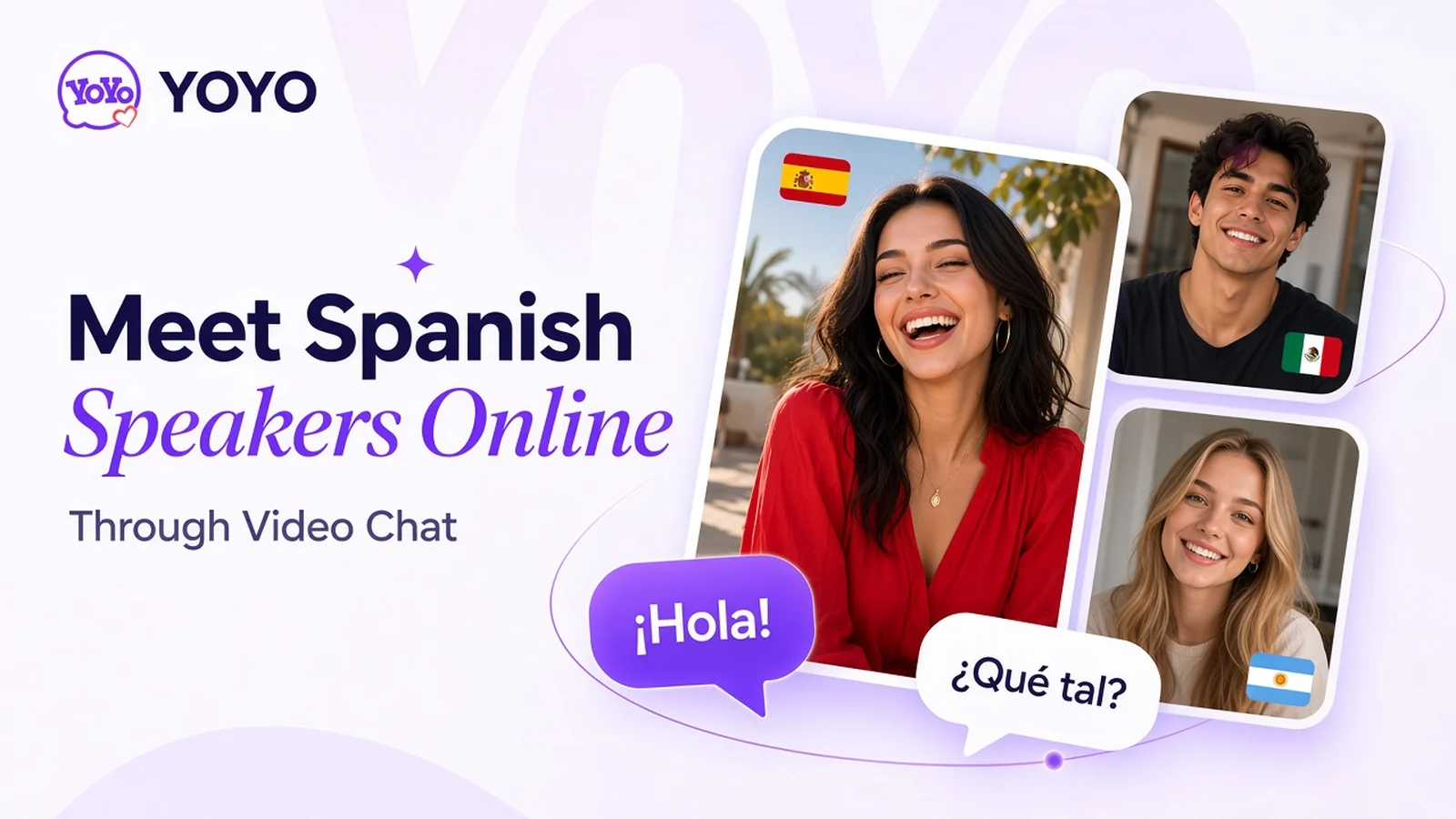
Spanish is spoken across numerous countries and communities, including Spain, Mexico, Colombia, Argentina, Peru and people living in the United States. Pronunciation, preferred words, slang and social routines differ. Even two people from the same country may use different expressions.
The goal is not to memorize every variety before you begin. It is to tell the other person what you are learning, then ask for clarification without embarrassment. If your partner says a word you have never heard, “¿Qué significa?” (“What does that mean?”) is often enough to keep going.
| Your goal | A good starting environment | What to ask for |
|---|---|---|
| Practice everyday Spanish | Language-exchange group | Twenty minutes with equal language time |
| Hear different accents | International conversation community | Permission to ask about unfamiliar words |
| Make a Spanish-speaking friend | Shared-interest social group | A call about the mutual hobby |
| Prepare for a trip | City-specific community | Practical conversations, not a free itinerary |
| Speak more confidently | Repeat partner or small group | Consistent short calls rather than rare marathons |
Where to find people who actually want to video chat
Language-exchange communities give you the clearest reason to approach someone. Before calling, ask how the partner wants to divide the time. For instance, a Spanish learner and an English learner can spend ten minutes in each language, followed by three minutes discussing interesting expressions.
Shared-interest spaces are often more natural for friendship. You might be interested in reggaeton, techno, football, illustration, gaming or photography. Contribute to a conversation first, then suggest a live call only if the community permits it. A specific invitation—“You mentioned that artist; want to swap favorites?”—feels much more human than “I want a Spanish speaker.”
Social video platforms can provide another starting point, but their mechanics vary. The iPhone version history for YOYO describes a friend-based interaction flow rather than anonymous random matching. If you use YOYO, verify whether its current Web experience has the social entry and language settings you need. Avoid treating marketing terms such as “international chat” as proof of an exact country filter.
Useful Spanish phrases for the first five minutes
Practice phrases that make sense in a real two-way conversation. You do not need an elaborate introduction.
| Spanish phrase | Meaning | When it's useful |
|---|---|---|
| Hola, ¿qué tal? | Hi, how's it going? | Opening casually |
| Mucho gusto | Nice to meet you | First introduction |
| Estoy aprendiendo español | I'm learning Spanish | Setting expectations |
| ¿Puedes hablar un poco más despacio? | Can you speak a bit more slowly? | When audio or pace is difficult |
| ¿Qué significa esa palabra? | What does that word mean? | Asking for clarification |
| Gracias por hablar conmigo | Thanks for speaking with me | Ending appreciatively |
| ¿Te gustaría hablar otra vez? | Would you like to talk again? | Suggesting a follow-up |
Different regions use different levels of formality and pronouns, including tú, usted and vos. You do not have to master all of them immediately. When in doubt, ask which form feels natural to your partner. The answer itself may become an interesting conversation about language.
First-call questions that don't sound like an oral exam
An overly formal question list can make both people tired. Instead, choose two or three topics that you personally care about:
- “¿Qué música has escuchado últimamente?” — What music have you been listening to lately?
- “¿Cuál fue la última película que te gustó?” — What was the last film you enjoyed?
- “¿Tienes algún pasatiempo nuevo?” — Have you picked up a new hobby?
- “¿Qué comida te gusta preparar?” — What do you like cooking?
- “¿Qué es lo mejor de tu ciudad para ti?” — What do you personally love about your city?
After a response, contribute your own example. If your partner says they enjoy a particular singer, mention an artist you like and ask whether they have heard of them. The goal is a conversation with two voices, not a language proficiency test.
If your partner corrects a sentence, try to use the corrected phrase once and move on. You will remember it better if it connects to an actual story.
A simple structure for a 20-minute language exchange
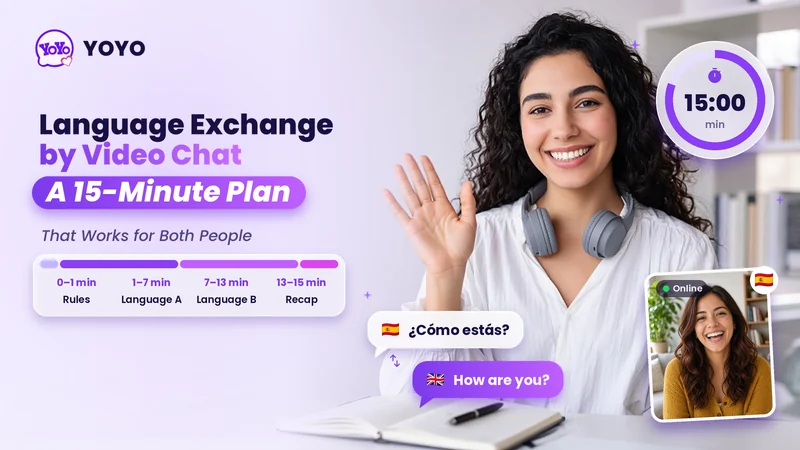
Minute 0–2: Check the microphone, agree on languages and ask whether corrections are welcome. Minute 2–9: Spanish first; discuss one shared topic. Minute 9–16: Switch to the partner's learning language. Minute 16–19: Share two useful expressions and clarify misunderstandings. Minute 19–20: Thank each other and ask whether another short call sounds good.
A common mistake is spending most of the call deciding what to discuss. Agree on one shared subject beforehand: an album, a photo you both took, a film or a small travel story. You can change course naturally once the conversation becomes interesting.
If video quality is poor, focus on audio and shorter sentences. A blurry face is inconvenient; lagged audio can make every exchange feel like an interruption. For troubleshooting, see our video chat freezing guide.
Time zones: Spain and Latin America are not one schedule
Someone living in Madrid will have a different daily clock from someone living in Mexico City, Bogotá, Buenos Aires or Los Angeles. Spain observes daylight saving time, while some Latin American locations do not. That makes a fixed “best time for Spanish chat” unreliable.
Ask for the person's city and local time zone only as far as needed to schedule; you do not need their neighborhood or address. Propose a dated, local-time invitation: “Could we talk for 15 minutes on Sunday at 6 p.m. your time?” Then translate it into your own calendar. If a region changes clocks seasonally, re-check the conversion for the actual date.
Avoid claiming that all Spanish-speaking users appear online during a particular hour. You are scheduling with an individual, not a country.
What to do when you understand only half the sentence
Do not pretend you heard everything and then answer a different question. Natural conversation allows repair. You can say “No entendí la última parte” (“I didn't understand the last part”) or “¿Puedes repetirlo?” (“Can you repeat it?”). Ask for the last phrase, not a complete restart of the conversation.
Sometimes your partner will use slang. Ask where the expression is commonly used. It is fine to collect a few regional phrases, but avoid performing a caricature of an accent. People usually appreciate genuine interest more than imitating their speech.
If a service offers translation, determine whether it translates text messages or spoken audio. The two are different features, and availability can vary by product and device. Our video chat translation guide explains what to check.
How to turn practice into a friendship
You do not have to become close friends with every conversation partner. When the connection is good, however, an ongoing shared interest can make the next call more natural than a repeated introductory exercise.
Suggest one small activity: trade photos of something interesting in your city, recommend a song, or watch the same short video separately and discuss it next time. Keep boundaries clear; don't request private contact information after a single call. If the other person prefers to stay on the original platform, respect that.
The online friendship guide offers more ideas for comfortable follow-up.
Frequently asked questions
Can I practice Spanish with native speakers on video chat?
Yes, if you find partners who want language exchange. Ask permission, offer time in a language you speak and keep the first call short enough to feel manageable.
Do I need to choose between Spain and Latin America?
Not necessarily. Different accents and vocabulary can enrich your practice. If you're preparing for a specific trip or exam, you may choose to focus on a particular variety at first.
What if I'm embarrassed by my accent?
Tell your partner your approximate level and focus on being understood. Short, clear sentences and a willingness to ask questions are more useful than trying to sound perfect immediately.
Can YOYO guarantee Spanish-language matches?
Do not assume so without checking the actual platform flow. Language options, translated messages, location discovery and user availability are separate things.
How often should we practice?
A short call you can both repeat is usually more sustainable than an ambitious schedule. Start with fifteen or twenty minutes and adjust based on mutual interest.
Conversation is the point
Speaking Spanish with another person becomes easier when you stop treating every sentence as a test. Bring a real interest, listen for the answer, ask for help when you need it and share something of yourself.
If you want to explore another social video option, visit YOYO and check its current Web experience before joining.