Maybe you started learning Japanese because you loved a film, a city, a game or the language itself. Maybe you are planning a trip and would like to hear someone's experience of everyday life rather than another list of tourist attractions. Or maybe you simply want to make friends outside your usual circle.
A good video conversation can help, but finding it requires more than typing “meet Japanese people” into a search box. The person on the other end should want the same kind of exchange, understand why you are contacting them and feel free to say no.
Quick answer: Join a genuine shared-interest community or language exchange, suggest a short voluntary call, and prepare two or three easy Japanese phrases. Schedule in Japan Standard Time (JST, UTC+9), which does not change with daylight saving time. If you use a social video app, verify its current discovery features rather than assuming a Japan-only matching filter exists.
Choose the connection you actually want
Some people are seeking conversation practice. Others want a new gaming friend or someone who likes the same music. The starting point changes with your aim.
| Your goal | Useful starting point | First message |
|---|---|---|
| Practice Japanese | A language-exchange group | “I can help with English if you'd like to practice Japanese together.” |
| Discuss music or film | A focused fan or creative community | “You recommended that album. What's your favorite track?” |
| Learn about everyday life | A city or local-culture discussion community | “What's a normal weekend like for you?” |
| Make a longer-term friend | Repeating hobby group or social video platform | “Would you like a short call about our shared hobby?” |
It is worth saying what you can offer, not only what you want. Language exchange is reciprocal. A stranger is not obligated to give you a free lesson about Japan, and an interest group is not a list of potential interview subjects.
Where to meet people without being intrusive
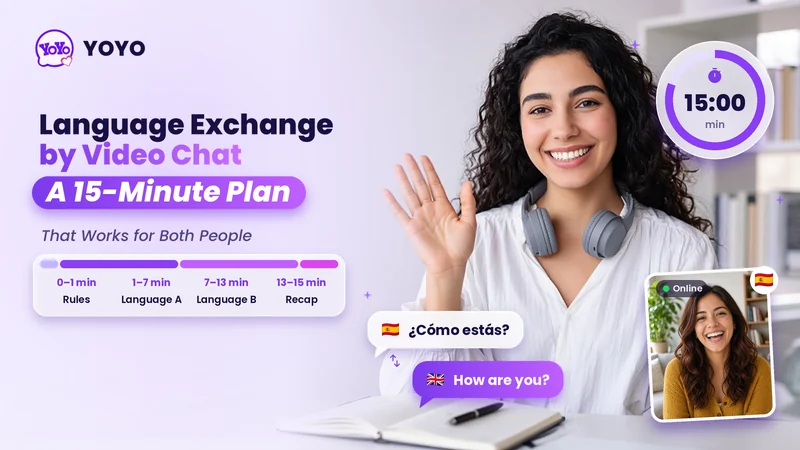
Language exchanges are practical because they establish expectations before the camera comes on. Agree on the language balance, the duration and how to handle corrections. For example, spend eight minutes in Japanese and eight in English, then discuss expressions that were difficult. This is gentler than interrupting every sentence.
Shared-interest communities provide an easier first topic. You might discuss a photography exhibition, a game update, independent music or a recent film. Contribute publicly first, then ask whether a one-to-one call is welcome if the community rules allow it. Avoid sending the same unsolicited message to dozens of people.
Social video services can help you find live conversation, but they differ in how they work. Some are random; others are account- and friend-oriented. YOYO has a social video experience, and its current iPhone version history describes mutual-friend communication rather than unrestricted anonymous matching. Check the Web flow separately; do not promise Japanese users on demand or a country filter that has not been verified.
For a broader view of platforms and international conversations, see International Video Chat.
Japanese phrases you can use in an actual call
A few ordinary expressions are more useful than a long list you cannot pronounce. Start slowly, then give the other person time to respond.
| Japanese | Romanization | Useful meaning |
|---|---|---|
| こんにちは | Konnichiwa | Hello / good afternoon |
| はじめまして | Hajimemashite | Nice to meet you (first introduction) |
| よろしくお願いします | Yoroshiku onegaishimasu | A polite phrase often used when beginning a relationship or activity |
| ありがとうございます | Arigatou gozaimasu | Thank you (polite) |
| また話しましょう | Mata hanashimashou | Let's talk again |
Yoroshiku onegaishimasu does not have one perfect word-for-word English equivalent. It often expresses goodwill or a request for a good ongoing interaction. You can say it after introducing yourself without pretending you have mastered every nuance.
Do not use exaggerated anime dialogue as your default speaking style unless you are specifically discussing that subject. People use different levels of formality with classmates, friends and strangers, and everyday conversation is usually less theatrical than a scripted scene.
Japan Standard Time makes scheduling easier
Japan uses JST, UTC+9 throughout the year, with no daylight saving change. That is handy: the Japan-side clock does not jump forward or back in spring and autumn. The difference between Japan and your country may still change if your country observes daylight saving time.
Use the city's local clock rather than a guessed conversion. If you live in the United States, don't assume your Saturday evening equals a convenient Japanese evening. Write a clear proposal: “Would Saturday at 8 p.m. JST work for a 20-minute call?” Then include your corresponding local time.
Work schedules and personal preferences are more important than a generic claim that “Japanese people are online at night.” Ask about the person's availability. A recurring, mutually agreed window is useful if you are planning language practice.
Your opening minute: a more natural approach
Start by explaining the context:
“Hajimemashite! We both like film photography, and I saw your post about that camera. Have you used it for night scenes?”
For language exchange:
“I'm learning Japanese, but I'm still a beginner. Would you be comfortable switching between Japanese and English for fifteen minutes?”
Both introductions allow an easy response. Neither expects someone to become your teacher or to describe an entire culture. If you stumble over a word, ask a precise question: “Is there a more natural way to say ‘I've been listening to this song all week’?” That is easier to answer than “Please teach me Japanese.”
Questions that work beyond textbook small talk
A memorable conversation usually has a shared object of interest. Try:
- “What's the last live performance or show you enjoyed?”
- “Is there a neighborhood you like visiting just to walk around?”
- “What's one dish you like making at home?”
- “What game have you spent the most time with recently?”
- “Do you prefer taking photos of people, architecture or everyday life?”
- “What's an English phrase that sounds strange when translated into Japanese?”
- “Is there a seasonal event you personally look forward to?”
- “What is one small thing that made this week good?”
If the other person mentions ramen, for example, ask whether they have a favorite style, then talk about something you have eaten. Do not immediately move to the next item on your list. A conversation is not a survey.
Be careful with cultural assumptions
Japan is not one personality type. Some people enjoy energetic introductions; others prefer a little more space. You cannot infer someone's comfort with eye contact, humor, personal questions or dating from their nationality alone. Follow the specific person's cues and ask directly when the topic matters.
A first call is rarely the place for questions about salary, exact home address or family plans. Nor is it fair to assume that an acquaintance must share your interest in anime, sushi or travel. Ask what they like instead of guessing what they should like.
If you are speaking across languages, avoid idioms and layered jokes at first. Short sentences, a slower pace and an occasional typed word help. If a translator is available in a product, confirm whether it handles messages or spoken audio; those functions differ. Our translation guide explains the distinction.
A simple 20-minute conversation plan
If you are anxious about running out of topics, agree to a structure without turning the call into a class.
Minutes 0–3: Say hello, confirm both people can hear and establish the preferred language. Minutes 3–8: Talk about the hobby that brought you together. Minutes 8–13: Share one object or story: a photo, a song, a book or a travel memory. Minutes 13–17: Ask a follow-up question and let the other person lead for a bit. Minutes 17–20: Thank them and decide whether you both want another call.
This is a scaffold, not a script. If the discussion becomes interesting, ignore the clock except for the end time you agreed to. Respecting that end time is a simple way to make future calls more likely.
What to do after a good first conversation
Send one specific follow-up, not a flood of messages. “I listened to that track you mentioned—thanks for the recommendation” is much better than “Hi” repeated five times. If the feeling is mutual, suggest a small next exchange: a playlist swap or a call to discuss one film. Leave plenty of room for the other person to decline.
You can build an online friendship without moving immediately to personal phone numbers. Keep private details private and use a communication space you both trust. Our online friendship guide covers how to follow up naturally.
Frequently asked questions
Can I meet Japanese people online for free?
Many language and interest communities let people participate without paying for individual conversations. A particular video service may charge for certain features; confirm its current rules before assuming a filter or call is free.
Do I have to be fluent in Japanese?
No. Be transparent about your level and ask whether the other person enjoys bilingual conversation. A simple introduction and shared topic are enough to begin.
What time zone is Japan in?
Japan Standard Time is UTC+9 year-round. Your own country may change clocks seasonally, so convert the date rather than memorizing a permanent offset.
Does YOYO guarantee matches with Japanese people?
No country guarantee should be assumed from an article. Check the live discovery and social features for the product and device you intend to use.
How can I avoid awkward pauses?
Keep one concrete shared topic ready and ask for stories rather than facts. A photo, song or film gives you something to react to together. A pause itself is not a problem.
Make the exchange mutual
Meeting a person from Japan can be the start of a friendship or simply a great conversation. Focus on the person, give as much as you hope to receive and keep the first call small enough that both people can enjoy it. The connection matters more than perfect grammar. If you are looking for a similar guide for Korean conversations, see how to meet Korean people online through video chat.
If you would like to explore another social video option, visit YOYO and check the current Web entry before joining.