You can memorize Arabic phrases for months and still freeze when someone says ahlan on a live call. Reading a language and talking to a person are two different experiences. The good news is that you do not need flawless grammar—or an elaborate introduction—to have a good conversation.
You do need to choose the right place, make your intentions clear and leave enough room for the other person to be a person rather than a free language tutor.
Quick answer: To meet Arabic speakers online, decide whether you want a language exchange, new friends or spontaneous social chat. Choose a platform where people are looking for the same kind of conversation, say what you hope to practice, and start with one specific question. If a service offers language or region preferences, check whether those are available to you before paying. A video chat platform cannot guarantee whom you will meet.
First, what kind of conversation are you hoping for?
“Meet Arabic speakers” can mean surprisingly different things. Someone preparing for a trip to Morocco might want short conversations with people familiar with Darija. An Arabic learner might want fifteen minutes of Modern Standard Arabic practice. Someone else might simply want friends who happen to speak Arabic.
Those are not interchangeable goals. Use the table to choose the right starting point.
| Your goal | Good place to begin | What to say upfront | What makes a good session |
|---|---|---|---|
| Practice speaking Arabic | Language-exchange communities or partners | “I'm learning Arabic. Would you be open to a short exchange?” | Both people get speaking time |
| Make friends | Interest-based social spaces or video chat | “I'm into films and photography. What are you into?” | You discover shared interests beyond language |
| Learn about a place | Local-interest communities and conversations | “I'm planning a trip. Can I ask what you love about your city?” | The other person is interested in sharing |
| Have a spontaneous conversation | Social or live video chat | “Hey, what kind of music have you been listening to?” | Nobody feels interrogated or pressured |
This distinction also keeps expectations fair. A conversation that begins with “please teach me Arabic for an hour” can feel like unpaid work. An invitation to swap stories, music recommendations or a few phrases is much easier to accept.
Arabic is not one single spoken experience
Arabic speakers live across many countries and communities. They do not all use the same dialect, accent or everyday expressions. Modern Standard Arabic is common in formal writing and media, while everyday speech often draws on regional varieties, such as Egyptian Arabic, Levantine Arabic or Moroccan Darija. People may also be comfortable speaking English, French or another language.
You do not need to master these differences before the first call. You only need to avoid assuming that a person from one Arabic-speaking region will speak exactly like someone from another.
If you're studying a particular variety, ask directly and politely:
“I'm learning Egyptian Arabic, but I'm still at beginner level. Is that something you're comfortable speaking?”
Or, if you're not studying at all:
“I'm curious about how people say everyday things in your part of the world. Is there a phrase you use all the time?”
A good conversation begins with curiosity, not a quiz about someone's identity.
Where to find Arabic-speaking people online
There are several routes, and each works for a different reason.
Language exchanges: best when practice is the point
Language-exchange communities work well when both people agree to help each other. You might practice Arabic for eight minutes and English for eight minutes, with a short warm-up and goodbye. Agree on the level and format first; some people want corrections, while others just want to speak without interruption.
Try a small, repeatable routine instead of asking an open-ended “Can you teach me?”: one topic, two useful new phrases and one question for next time. If a practice session goes well, agree on a topic for your next conversation.
Shared-interest communities: best when friendship is the point
A photography group, music discussion or travel community often gives you more to talk about than a nationality filter. Join for the topic first. If someone is comfortable moving to a live conversation later, you already have common ground.
Avoid treating the group as a directory of people to contact privately. Read the rules and ask before inviting someone to video chat.
Social video chat: best when you want to talk now
Live video conversation removes the long wait between messages. It can be a natural way to hear a language, read facial expressions and notice whether you actually enjoy talking together. But services vary in how they introduce people: some use spontaneous matching, while others emphasize profiles and ongoing social connections.
YOYO Video Chat is one option to explore for social video conversations. Check the current Web experience before you start, including whether it asks you to sign in and what connection options are available. Do not assume YOYO offers an Arabic-language filter or guaranteed country matching; those features must be verified in the live product.
You can also compare different approaches in our guide to international video chat and video chat with translation.
Five opening lines that actually invite a reply
“Hi” is fine. “Where are you from?” is fine too—but it becomes repetitive when it is the only thing you ask. Specific, light questions give someone more room to respond.
- The music opener: “What's one song people around you are playing all the time right now?”
- The everyday opener: “What does a normal weekend look like for you?”
- The food opener: “What's a dish you think visitors should try at least once?”
- The language opener: “What's a phrase you use with friends that textbooks never teach?”
- The shared-interest opener: “I'm looking for a new show to watch. What would you recommend?”
Follow the answer instead of moving down the list. If someone recommends a song, ask when they first heard it or what they like about it. That makes the interaction feel like a conversation rather than an interview.
A few Arabic phrases that can break the ice
You can start in English and add a word or two of Arabic. The phrases below are widely recognizable, but pronunciation and everyday wording vary by region. They are conversation starters, not a universal script.
| Arabic | Approximate pronunciation | Meaning | When to use it |
|---|---|---|---|
| مرحبًا | marhaban | Hello | A friendly opening |
| أهلاً | ahlan | Hi / welcome | A casual greeting |
| شكرًا | shukran | Thank you | After someone helps or shares something |
| أنا أتعلم العربية | ana ata'allam al-arabiyya | I'm learning Arabic | To set expectations honestly |
If you're a beginner, explain that you may switch languages. Try: “I know a few Arabic words. Would you mind if I practice one sentence, then we can speak English?” That gives the other person an easy way to say yes or no.
The most useful phrase may be a question in a language you both understand: “Would you prefer Arabic or English?”
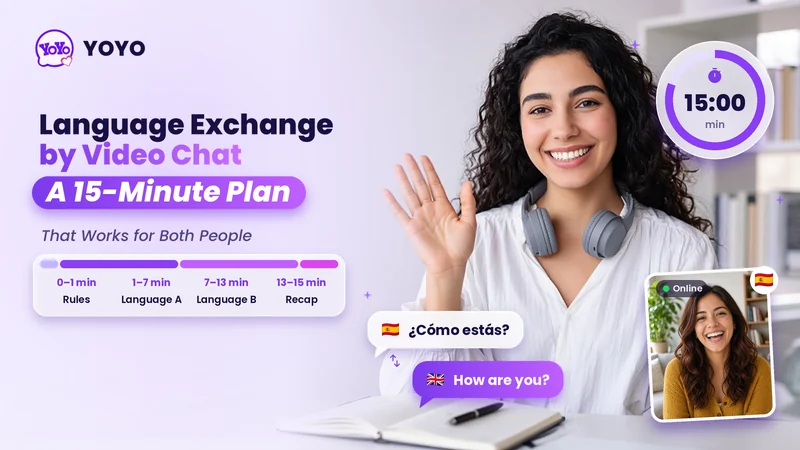
A fifteen-minute first-call plan
You don't need a long call to decide whether you click with someone.
Minutes 0–2: Establish comfort. Say hello, ask what they prefer to speak and share a small detail about yourself. “I'm listening to a lot of electronic music lately” works better than reciting your entire biography.
Minutes 2–6: Find one shared topic. Music, food, travel plans, books, films and photography are accessible starting points. If the other person seems disengaged, change topics once rather than pushing.
Minutes 6–11: Swap stories. Ask for a memorable experience, not just a fact. “What's a place in your city you'd actually take a friend?” invites a story; “Name three tourist attractions” invites a list.
Minutes 11–13: Make language practice optional. If both of you are interested, exchange one phrase each. If not, stay with the conversation.
Minutes 13–15: End well. Say what you enjoyed and ask whether they'd like to talk again. A short call that ends naturally is better than forcing an hour with someone who is ready to leave.
How to avoid uncomfortable cross-cultural assumptions
Being interested in another language or culture is a good starting point. Treating someone as a representative of millions of people is not.
Avoid opening with assumptions about religion, family rules, relationships or politics. These subjects may come up naturally once you know each other, but they should not be a test the person has to pass. Don't assume everyone in an Arabic-speaking country is Muslim, or that everyone who speaks Arabic lives in the Middle East.
Keep questions personal and optional: “Do you celebrate anything special around this time of year?” is more inviting than “So all of you celebrate X, right?”
If something is unfamiliar, ask without making the other person defend it: “I don't know much about that. Would you be comfortable telling me more?”
A practical safety checklist for your first calls
A live conversation can feel personal very quickly. Keep a few boundaries in place while you're still getting to know someone.
- Don't show documents, your home address, work screens or other identifying details on camera.
- Use a neutral display name and check what is visible behind you.
- Do not send money, gift cards, account codes or identity documents to someone you've just met.
- If someone insists on moving to another app immediately, you can decline. Continue only where you feel comfortable.
- Ask before recording or taking a screenshot. If a platform provides reporting or blocking, use those controls when needed.
See our guide to talking with strangers online for more ways to choose an interaction format that feels comfortable.
How to turn one pleasant call into an actual connection
The simplest follow-up mentions something real from the conversation:
“I listened to the song you mentioned and loved it. Thanks for the recommendation. Want to trade another one sometime?”
It is specific, low-pressure and gives them a reason to reply. If you exchanged language tips, offer the same benefit back. If they are busy or don't respond, leave it there. Friendship requires mutual interest.
You can also make the next conversation easier by suggesting one small idea: a five-minute check-in, comparing two favorite tracks or each showing a nonpersonal photo you've taken recently.
FAQs
Can I meet Arabic speakers online for free?
Some communities and services offer free ways to start. Other features, filters or longer calls may require an account or payment. Check the current terms before relying on a feature. “Free to download” does not mean every call is free.
Do I need to know Arabic before joining a video chat?
No. Be upfront about your level and ask what language the other person prefers. A respectful beginner who listens is often a better conversation partner than someone who pretends to be fluent.
Can I choose to talk only to people in Arabic-speaking countries?
That depends on the platform. Some services advertise country or language filters, but their availability and price vary. YOYO's current Web options should be checked directly; don't treat this article as a promise of location targeting.
Is Modern Standard Arabic enough for casual conversations?
It can help you be understood, especially in a learning context. Everyday conversations may use regional dialects, so ask what variety the other person normally uses and take it as a chance to learn.
What's the easiest conversation topic for a first call?
Try music, food or a shared hobby. Ask one specific question, listen and follow up naturally. You're trying to connect with a person, not complete a worksheet.
Start with the person, not the language label
If your only goal is to find “an Arabic speaker,” every conversation can feel like a search result. If your goal is to meet someone interesting and maybe pick up a few words along the way, the experience is much more human.
Choose a conversation format that fits your intention, keep your first call short and let the next one be earned by mutual curiosity. To explore a social video chat experience, visit YOYO and check its current Web entry and available features before you begin.