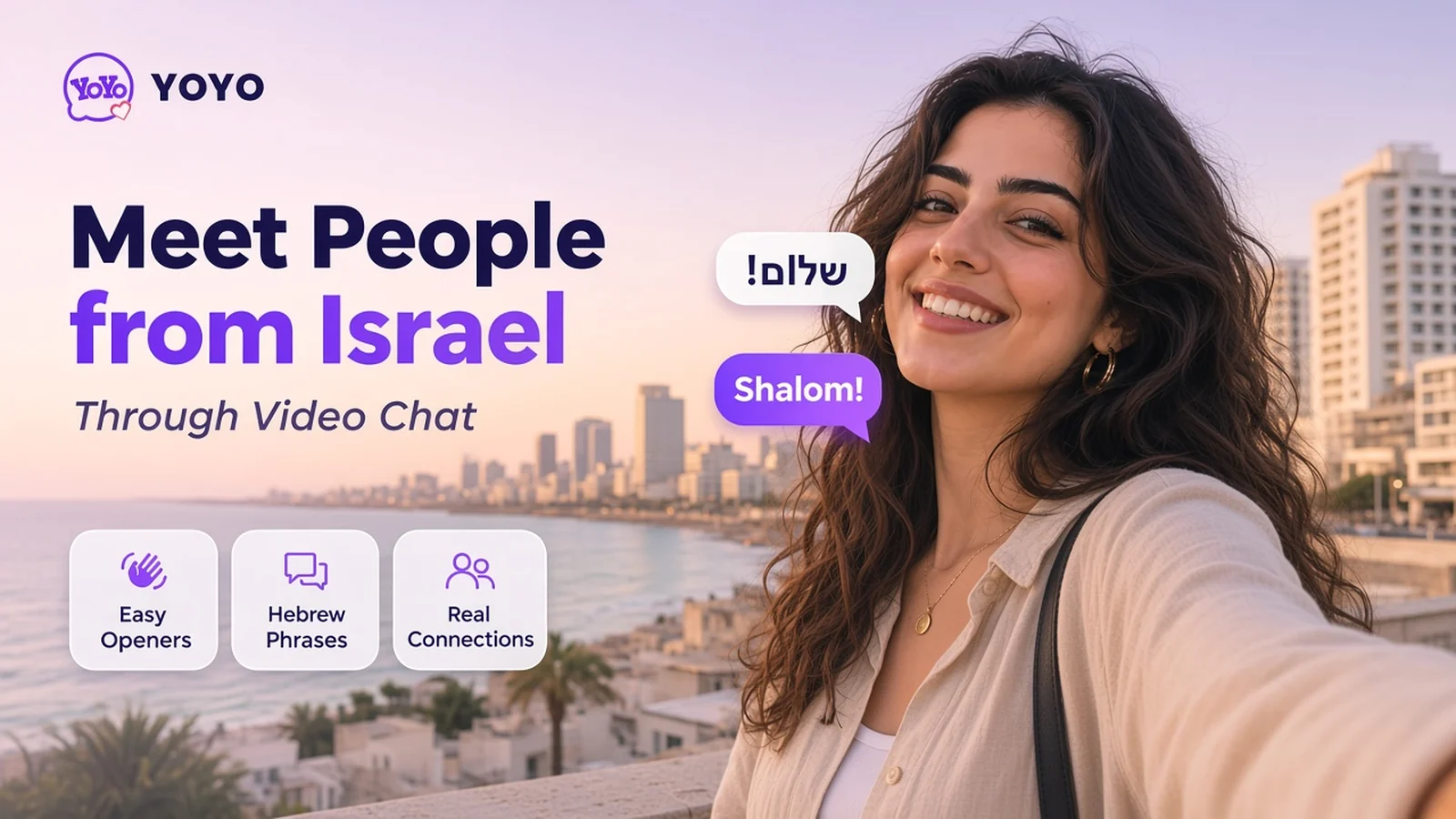
You might want to learn everyday Hebrew, ask someone what life is like in Tel Aviv or Haifa, trade music recommendations, or simply make a friend whose experience is different from yours. A live video call can be a much more natural starting point than collecting short comments on social media. You hear tone, catch humor and can follow a question in real time.
The useful goal is not to “find an Israeli person” as if everyone in a country has the same story. It is to find someone who actually wants to talk, in a community where you share enough interest to have a conversation worth continuing.
Quick answer: Start in a language exchange or shared-interest group, confirm that live calls are welcome, and suggest a short conversation. Prepare one or two Hebrew greetings, check the time in the other person's city and ask about everyday interests rather than treating someone as a representative of national politics. If you try a social video platform such as YOYO, verify the current country discovery and contact options instead of assuming it guarantees matches in Israel.
Decide what you hope to get from the call
A language practice partner, an online friend and someone willing to answer travel questions may all be interested in different conversations. Be transparent about the experience you want. It makes the first invitation much easier for the other person to evaluate.
| Goal | Good place to begin | Natural invitation | A boundary to respect |
|---|---|---|---|
| Practice Hebrew | Language-exchange community | “Could we do ten minutes of simple Hebrew and ten of English?” | Don't expect free tutoring |
| Make a friend | Music, games, photography or film groups | “You mentioned that concert—want to talk about it sometime?” | Don't pressure someone to share contact details |
| Learn about a city | Community centered on the city | “What's one café or neighborhood people overlook?” | Avoid asking for an exact home location |
| Meet new people casually | Social video conversation platform | “Would you be up for a short chat about music or travel?” | Don't assume everyone is there for dating |
Start with a shared interest, not a demographic checklist. For example, electronic music, basketball, cooking, photography and books all create room for a reciprocal conversation. You can also offer something: a playlist, a recommendation or practice in a language you speak.
Where to find a willing conversation partner
Shared-interest communities are excellent because a discussion already exists before you suggest a call. Join one, participate sincerely, and notice whether members organize live events. If the community has rules against unsolicited direct messages, respect them. A public conversation is not permission to call privately.
Language exchanges provide clearer expectations. You are both learning, and you can divide the time fairly. A fifteen- or twenty-minute call is usually easier to agree to than “We should talk for hours.” Ask whether corrections are welcome. Some learners want every mistake noted; others simply want confidence speaking aloud.
Social video platforms are another possibility if you would rather start with conversation than a formal study session. YOYO is worth exploring for social interaction, but check its actual Web and app entry paths. Its iPhone version history describes friend-based calling rather than anonymous random chat. Do not claim that a specific Israel filter exists unless it is visible and tested in the current product.
For a broader explanation of cross-border calling, see our international video chat guide.
Five Hebrew expressions that make a genuine start
You do not need to become fluent. A small effort is enough to signal that you are interested in the other person's language.
| Hebrew | Simple transliteration | Meaning | How to use it |
|---|---|---|---|
| שלום | Shalom | Hello / peace | An easy greeting |
| מה נשמע? | Ma nishma? | How's it going? | Casual opener |
| תודה | Toda | Thank you | After help or a correction |
| בבקשה | Bevakasha | Please / you're welcome, context-dependent | Polite everyday phrase |
| להתראות | Lehitraot | See you / goodbye | At the end of a call |
Pronunciation varies, and Hebrew has forms that change with gender and context. Avoid pretending that a short cheat sheet covers the entire language. If you use a phrase, you can add, “Did I pronounce that right?” It gives the other person an easy opening to respond.
Many people in Israel communicate in Hebrew, but there are also Arabic speakers and people with other first languages. Ask what language the person prefers. Do not assume language, ethnicity or religion based on their location.
Plan around the time difference—without guessing someone's routine
Israel observes daylight saving time in part of the year. In 2026, the clock changed to summer time on March 27 and returned to standard time on October 25. That means Israel is UTC+3 during summer time and UTC+2 during standard time. A convenient hour for someone elsewhere can become a very late night for an Israeli contact.
Instead of memorizing a fixed gap, schedule using the other person's city and a specific date. If you are in New York or Los Angeles, include your local city as well, because the United States changes its clocks on different dates from Israel. A message such as “Would 8 p.m. your time on Thursday work?” is clearer than “Let's talk at 8.”
Never treat national holidays, religious observance or work schedules as universal. People keep different routines. Ask what day actually works for them.
A first-call script that isn't an interview
A friendly opening can be uncomplicated:
“Hey, thanks for making time. I'm into street photography and live music. What have you been listening to lately?”
If you connected through a language group:
“Shalom! I'm learning a few Hebrew phrases, but I'd love to have a normal conversation too. What should I watch or listen to this week?”
Then follow the answer. If the other person mentions a musician, ask how they discovered them. Share your own favorite before moving to another question. A conversation feels balanced when each person adds something, not when one person collects facts.
Questions that lead to stories
The best questions give the other person a choice about how personal to be. Try these:
- “What's one local artist you think more people should know?”
- “Is there a food you associate with a good weekend?”
- “What's something visitors often misunderstand about your city?”
- “Have you discovered any good books or shows recently?”
- “What do you like doing when you have a free afternoon?”
- “If we traded playlists, what would you put on yours first?”
- “Is there a hobby you're currently learning?”
- “What's an expression in Hebrew that's hard to translate?”
All of these invite ordinary human details. You can ask about current events if both people want that discussion, but do not assume someone wants to debate a conflict, defend a government or explain painful events to a stranger. It is reasonable for either person to change the subject.
What if the conversation gets awkward?
A pause is not automatically a failure. Video calls are especially sensitive to small delays, uncertain language and background noise. A good reset is a specific observation: “You mentioned photography earlier—what kind of camera do you use?” Another option is to acknowledge the pause lightly: “I think we ran out of small talk. What's the best thing you watched this month?”
If someone seems uncomfortable, check rather than pushing. “Would you rather change the subject?” is enough. If they want to finish the call, end politely. Having a respectful conversation includes knowing when not to continue.
If there is a language barrier, shorten your sentences and avoid idioms. You can type a noun or name in chat if the platform supports it, but do not assume live voice translation exists. Our video chat with translation article explains the differences between messages and subtitles.
From a first hello to another conversation
If you both enjoyed the call, suggest a small next step. “Would you like to swap one song and talk about it next weekend?” is easier than asking someone to become your close friend immediately. Let the other person decide whether, where and when to stay in touch. Avoid sharing a full address, financial details or work schedule just to prove that you trust someone.
If there is no second call, the first conversation can still have been worthwhile. You learned a new pronunciation, heard a story or found a good song. Connection does not require a promise of permanence.
Frequently asked questions
Can I meet people from Israel online without a dating app?
Yes. Shared-interest groups and language-exchange communities are good alternatives if you're looking for conversation rather than dating. Check each community's rules for live calls and messages.
Do I need to speak Hebrew?
No. Ask the other person which language they prefer. Knowing a greeting such as shalom can help, but it is not a substitute for mutual understanding.
Can YOYO match me only with people in Israel?
Do not assume so. Check its current Web and app interfaces for available discovery options. A social platform's user base or matching filters should not be inferred from a blog title.
What time should I video chat with someone in Israel?
Agree on a specific date and use the time in the other person's city. Israel shifts between UTC+2 and UTC+3 seasonally, so a fixed year-round difference may be wrong.
What topics should I avoid on a first call?
Start with interests. Do not demand personal information or political opinions, and let the other person decide what they are comfortable discussing.
Start with curiosity, not a perfect sentence
A real conversation with someone from Israel will not fit a national stereotype or an online checklist. Find a space where both people want to talk, learn a greeting, show up at the agreed time and follow the story the other person chooses to share.
If you are exploring a social video platform, check YOYO and its current browser entry before your first call.