A first video call can go wrong before either person has said anything interesting. Your microphone is muted, a second tab is playing a video, or you begin with a question that sounds like an interview. None of these makes you a bad conversationalist. They simply add friction to a moment that is already new.
A good first impression has less to do with looking perfect and more to do with being easy to talk to. Can the other person hear you? Do you seem interested? Do you respect their pace? Can you move beyond a generic hello without making the exchange feel forced?
Quick answer: Check audio and framing before joining, greet the other person naturally, share a little context and ask one question with room for a story. Listen to the answer instead of immediately asking something else. End kindly and only suggest another call if the interest feels mutual.
The 90-second setup that matters more than your camera quality
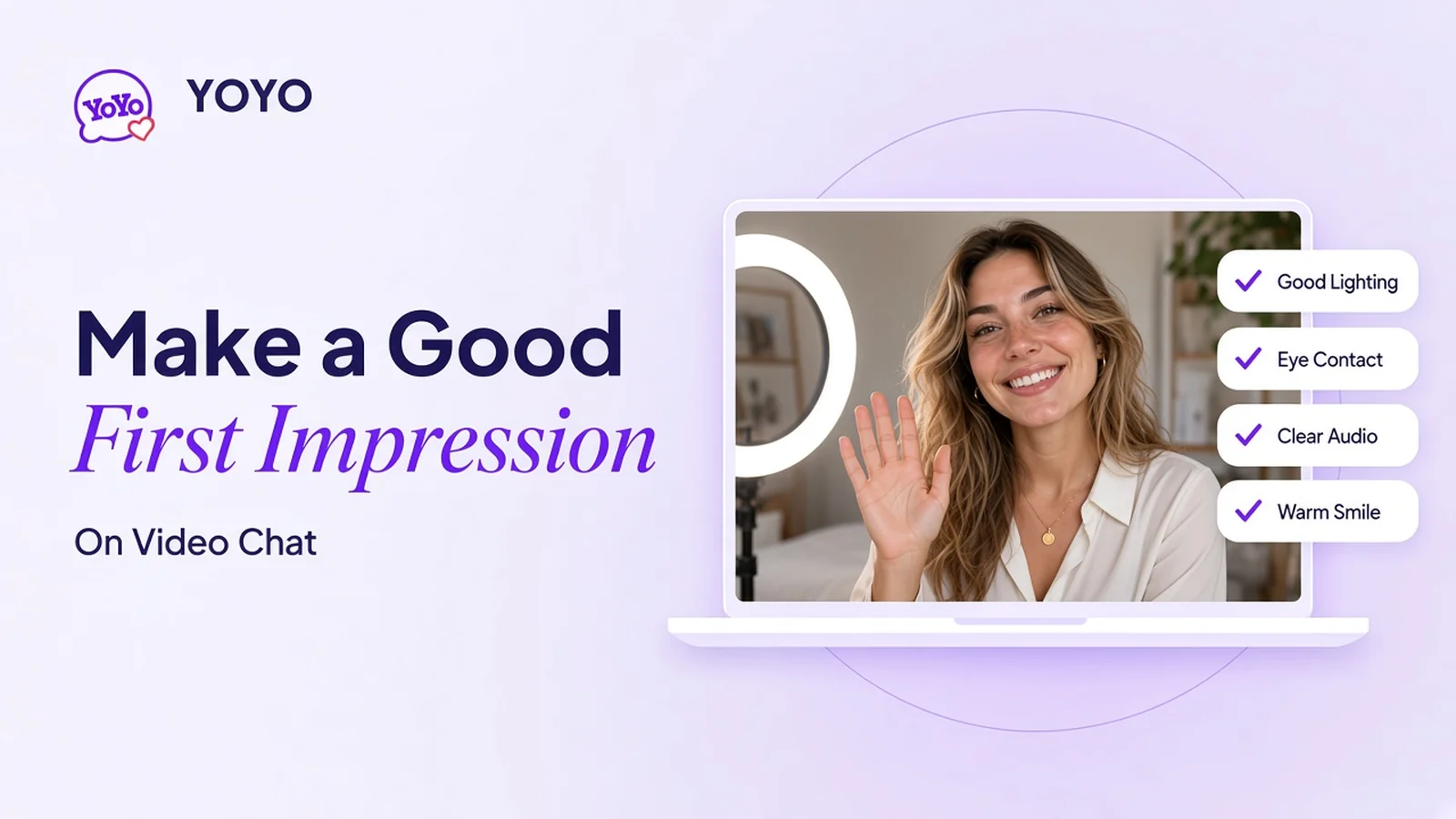
First, test the microphone. People are usually more forgiving of imperfect video than unclear audio. Use the device's settings or a safe local test to confirm which microphone is selected. Close other apps that may take control of audio. Put on headphones if the speakers create feedback.
Second, look at the frame. Move the camera to a comfortable height and use a light source in front of you rather than a bright window directly behind. Your face does not need professional lighting; the other person simply needs to see your expressions. Remove documents, mail and anything with an address from the frame.
Third, check your connection and browser permissions. A stable connection and allowed camera/microphone access are enough for a first call. If you're using Chrome, verify that permission applies to the specific website rather than turning on access indiscriminately. If it still fails, see our camera and microphone troubleshooting guide.
| Before the call | Quick test | Why it matters |
|---|---|---|
| Microphone | Say a sentence in a local test | Prevents silent introductions |
| Speaker/headphones | Play a short sound | Avoids repeating everything |
| Camera | Check what is visible behind you | Keeps the frame comfortable and private |
| Notifications | Pause unnecessary pop-ups | Reduces distractions |
| Timing | Know when you need to leave | Avoids abruptly disappearing |
Start with a greeting and one piece of context
The strongest introduction is rarely the cleverest one. Try something ordinary:
“Hey, nice to meet you. I saw you're into photography too. Have you been shooting anything interesting lately?”
Or if there is no shared profile context:
“Hi, good to connect. I've been on a big film kick this week. Have you watched anything you'd recommend?”
Those openings do three things: acknowledge the person, reveal a real interest and invite a reply. They also give you somewhere to go after the first answer. A question without context—“What do you do?”—can be fine, but it often produces a short factual response.
Avoid launching into an elaborate personal story before knowing whether the other person wants to hear it. Your first sentence should open a door, not take over the entire room.
Listen like you actually want the answer
Listening is visible on video in small ways. You let the other person finish. You react to what they said. You make the next question connected to the previous answer. You do not stare at your own self-view throughout the call.
Suppose someone says they like painting at night because their house is quiet. A natural follow-up is “Does the quiet help you focus, or is it just when you have time?” That shows attention. Switching immediately to “What's your favorite sport?” may make it seem as though you are reading from a checklist.
Share your own answer as well. A balanced conversation usually alternates observation, response and follow-up—not a string of questions from one side.
Good questions open stories; bad questions demand access
You do not need to avoid personal topics forever. You simply need to earn the right moment. These examples show the difference:
| Instead of... | Try... | Why it's better |
|---|---|---|
| “Where exactly do you live?” | “What's something you like about your city?” | Invites a story without exact location |
| “How much do you earn?” | “What kind of work or projects do you enjoy?” | Respects private finances |
| “Why are you single?” | “What brought you to this community?” | Avoids assuming dating intent |
| “Are you free every night?” | “What sort of call schedule works for you?” | Makes boundaries explicit |
| “Tell me your biggest secret” | “What's a hobby you could talk about for hours?” | Keeps first-call pressure low |
Not every conversation needs to feel like deep friendship on day one. Shared curiosity is plenty.
How to sound more natural when you're nervous
Trying to deliver a polished sentence can make you sound less like yourself. Use short, direct language. A genuine “I don't know much about that—what got you interested?” works better than pretending expertise.
If you interrupt accidentally, say “Sorry, go ahead.” If an audio delay makes both of you speak at once, pause and let the other person finish. If you lose a word while speaking another language, ask for help. These are normal conversational repairs, not failures.
You can also acknowledge the setting: “I always need a second to get used to a new video call.” You don't need a dramatic apology. A little natural humor can make the interaction more relaxed if the other person responds positively.
Let the other person choose the pace
Some people are expressive from the first minute. Others take time to warm up or prefer slower questions. Match the available energy without imitating someone's personality. If their answers are short, give the question room rather than repeating it louder or making it more personal.
A good adjustment is to offer an example: “I have been listening to a lot of old-school dance music lately. What about you?” The person now has context and can answer at whatever level feels comfortable.
If the person looks distracted, you can ask if the timing is inconvenient. If they want to end, respect that. Being gracious when a conversation doesn't take off is part of making a good impression too.
Don't accidentally turn friendliness into pressure
Compliments, flirting and personal questions are not universally welcome in general social video spaces. You may be talking with someone who wants language practice, friendship or a discussion about a shared hobby. Do not assume they are looking for a date because they are on camera.
Likewise, avoid insisting on exchanging phone numbers or social handles immediately. When a second call sounds appealing, suggest it as an option: “I had fun talking about this. Would you be interested in continuing next week?” A yes should be genuine, not extracted after repeated requests.
What to do if your call gets awkward
A brief silence is normal, especially when someone needs time to translate or a connection introduces a delay. Before you assume something is wrong, wait one or two beats. You can then follow an earlier topic: “I meant to ask about that artist you mentioned. How did you discover them?”
If the microphone is failing, explain the issue rather than silently disappearing: “I think my audio is cutting out. I'm going to reconnect once.” If it keeps failing, agree on another time. A graceful exit may leave a better impression than spending fifteen frustrating minutes trying to rescue broken sound.
A clean way to end the call
One of the nicest things you can do is respect the time you agreed on. If you said fifteen minutes, acknowledge the end even if the conversation is going well: “I need to head off in a minute, but I've really enjoyed this.”
If a follow-up is mutual, mention one detail you want to revisit: “Send me the name of that documentary if you remember it.” That is more meaningful than a generic promise to “chat sometime.” If it is not mutual, simply thank the person and leave it there.
For more about continuing a connection, see turning a first video chat into an online friendship.
Choosing the right platform affects the impression
A product's mechanics shape the first ten seconds. Random matching starts with surprise and little context. Account-based social chat may give both people more information about why they are speaking. Language exchange has an explicit educational purpose. None is automatically better; the useful question is whether your introduction matches the expectations of the space.
YOYO offers a social video experience to explore. Its iPhone version history describes mutual-friend communication, so do not market it as guaranteed anonymous roulette. Check the current Web flow and any sign-in steps before choosing it for a first conversation.
Frequently asked questions
What should I say first on video chat?
A warm greeting, one bit of context and an open-ended question are enough. “I saw you like photography—what have you been shooting?” creates an easy path into a conversation.
Does camera quality matter?
Clear audio, readable facial expressions and a comfortable frame generally matter more than expensive equipment. Avoid a bright window behind you and check that the microphone works.
What if the other person doesn't ask me questions?
Share a little about your own interest and see whether the exchange becomes balanced. You do not need to force a long call with someone who is not engaging.
Should I give someone my social account after one call?
Only if you both want to and you are comfortable with what the account reveals. Keeping communication on the original platform initially is a reasonable choice.
How long should the first video call last?
A short, clearly agreed call—perhaps fifteen or twenty minutes—is often easier to manage than an open-ended one. You can always decide to speak again.
Leave people feeling heard, not impressed
A memorable first video chat usually has an ordinary shape: someone feels listened to, shares a genuine laugh and leaves with the sense that they were not being judged or rushed. Preparation makes that easier, but the connection itself comes from attention and respect.
For a social video option, visit YOYO and verify the current way to start a conversation.